
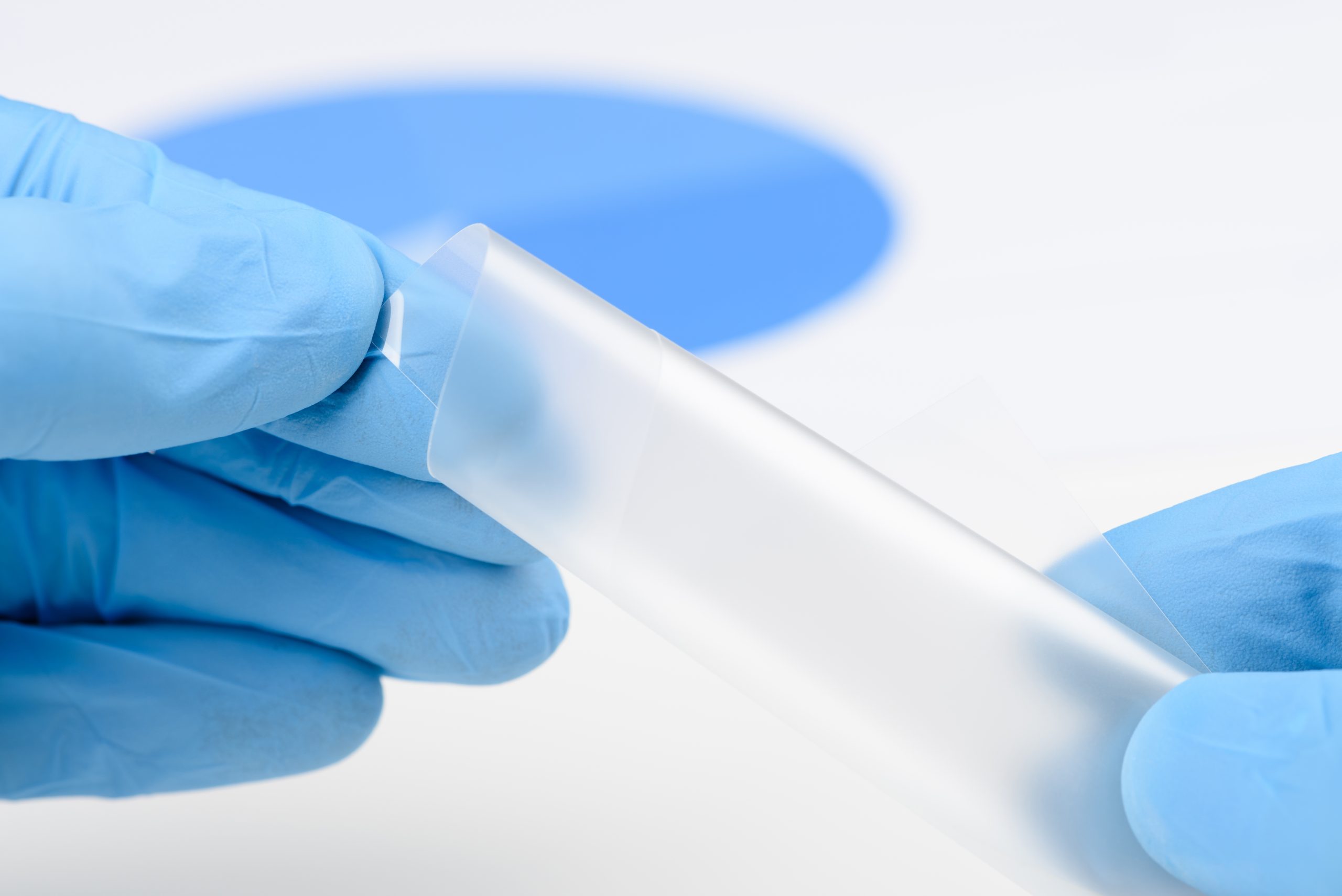

Jurata Thin Film began as an idea to develop a novel way to deliver Ebola vaccines to low-income countries without the specialized storage capabilities needed for a live vaccine. MSI-TX thin film, Jurata’s flagship technology, was created by Maria Croyle, RPh, PhD, at the College of Pharmacy at the University of Texas at Austin. The film can uniquely stabilize live material three-dimensionally for up to three years without vials, temperature control, or large shipments.
Sheila Ann Mikhail, owner of the gene therapy company AskBio, took an interest in Croyle’s technology and founded Jurata Thin Film in 2019, with Croyle as the scientific founder. Sheila is a Mexican-American entrepreneur with an MBA and a law degree who has established several life-science-related ventures varying from biotech development to philanthropy to a life-science law firm.
The Challenges
Current methods for storing, transporting, and administering vaccinations require significant resources and can be extremely costly. This, in part, is why vaccination rates in third-world countries lag at 23%, far behind the first-world standard of 80%.
Shipping and Storage
Most vaccines require cold-chain practices, meaning that the temperature of the live material needs to stay under a specific value from conception to administration to ensure structural integrity. The temperature control values range from -4 degrees Fahrenheit to -94 degrees Fahrenheit, which presents logistical challenges for transport. It is estimated that over half of the cost of vaccination is attributed to shipping and storing logistics. Shipping a container full of vaccine doses that can maintain optimal temperature is costly and may not necessarily be supported by the receiving laboratory. One study investigated laboratory storage infrastructure in third-world countries and found that:
“…only 76% had a functional thermometer in use. Of those, 20% had recorded temperatures that fell outside those recommended by vaccine manufacturers. This was primarily due to vulnerabilities in the power grid and lack of alternative sources of electricity…”
Shipping and storing vaccines at ambient temperature removes a giant barrier to vaccination in disadvantaged countries, drastically reducing costs and resources needed by allowing more accessible storage, distribution, and inoculation. In addition to the reduction in resources required for cold storage, the film replaces the need for glass or plastic vials, further decreasing cost as well as its physical footprint. All of these factors have enormous implications for improving global health through access to vaccination.
The International Air Transport Association (IATA) estimates that the resources needed to vaccinate every person against COVID-19 would require at least 16,000 jumbo jets to deliver the vaccine using current transport methods. The same volume of vaccines can be delivered using thin film in only 4 jumbo jets.
Administration Route
Thin film can deliver vaccine payloads sublingually (under the tongue) or buccally (in the cheek) without the contamination risks that come with injection, or the cost of hiring medical professionals to administer the injection. In lower-income countries, medical providers may not be readily available or within budget limitations. Not only does vaccination by injection incur costs of its own–such as the cost of clean needles or solvents to prepare the vaccine–but it also gives rise to human error and, ultimately, vaccine resource wastage. This change in administration route decreases the need for the participation of medical professionals, lowers wastage, diminishes health risks, and further reduces the monetary barrier to improving vaccination rates.
Studies have shown that acceptance of and compliance with vaccine doses is higher when not delivered via injection. Mucosal delivery methods present a much quicker and more efficient inoculation method in large populations or the event of a pandemic and enables stockpiling of doses due to the remarkable stability of the film. The vaccine can also be rehydrated in a solution to administer via injection or nasal spray, if needed.
The Science
Vaccines expose your immune system to a small amount of the selected virus that is either incomplete or altered to incite the creation of antibodies against a disease. Those antibodies are then ready to go when coming into contact with the actual virus, better equipping your body to fight off the disease. Emerging research suggests that the mucosal immune response differs from the systemic response garnered by intramuscular or subcutaneous delivery routes. One study found that mucosal immune responses are superior because they may prevent initial infection rather than just halting disease progression after initial infection, like regular vaccines.
The Future
Jurata Thin Film’s mission statement asserts that they want to make life-saving therapies available worldwide, regardless of resources, and they are actively working toward that goal. They have significantly expanded their manufacturing over the last few years and have received large infusions of money from several sources, most recently Johnson & Johnson. J&J’s partnership with the Biomedical Advanced Research and Development Authority has yielded a program called Blue Knight, which awards funding to up-and-coming companies that directly contribute to resolving current public health difficulties. Jurata Thin Film was the awardee of the grant this past cycle and will be using those funds to support its current initiatives. Jurata hopes to attain the regulatory approvals needed to commence human clinical trials in 2024 and plans to expand the usability of the film to encompass the transportation of enzymes, intact bacterial species, sustained time-release therapeutics, and more.